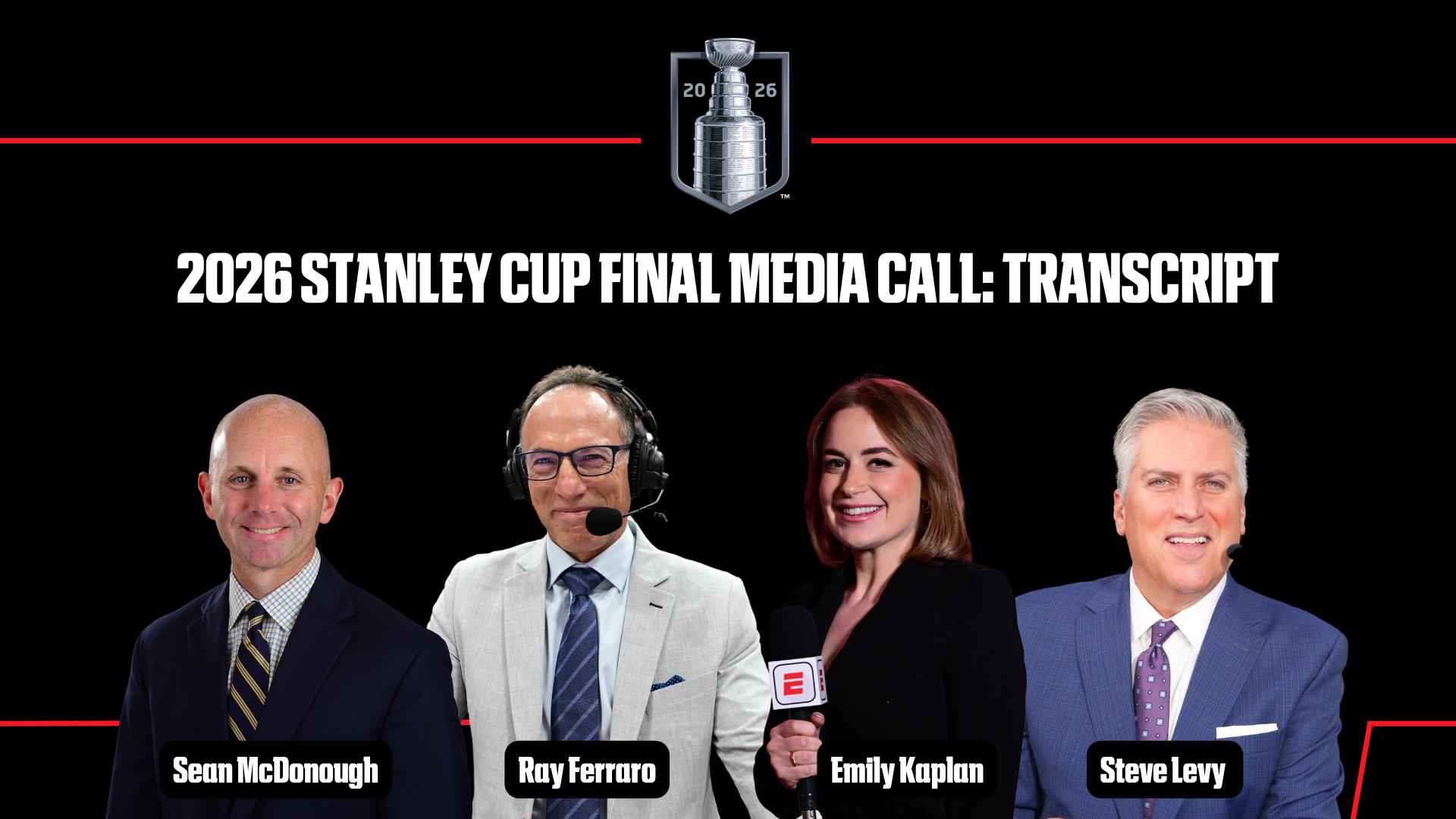
Today, ESPN NHL commentators Sean McDonough, Ray Ferraro, Emily Kaplan and Steve Levy were joined by media for a discussion of the 2026 Stanley Cup Final, which continues tonight, Thursday, June 4 on ABC. More on ESPN’s coverage here.
A TRANSCRIPT OF THE CONVERSATION IS BELOW:
THE MODERATOR: I’ll get this started off. Can each of you share some brief thoughts on the series following Tuesday’s game and the overall momentum of the NHL?
SEAN McDONOUGH: Thanks for organizing this and hello to everybody. It’s been a tremendous start to the series. I think Game 1 was a classic, and it wasn’t really a surprise to the four of us, and I think most people who follow hockey closely, these are two really evenly matched teams who play an exciting style.
There was a lot of history made in the first game, goals scored in the first 30 seconds of each of the first two periods, that’s never happened before. A road team never came from multiple goals down to win Game 1 of a Stanley Cup Final. That happened. It was a lot of great action, a lot of back and forth, and a lot of great story lines, and I think we’re going to see more of the same, maybe for another six games, who knows?
RAY FERRARO: I was a little surprised with the number of goals. I think, when we were going over it, Sean, we thought it was going to be super tight and really physical and really fast, which it was all of those things, except I didn’t think there would be nine goals. I thought it was a really fun, kind of exciting game. I’m sure the coaches would like it to be a little more dialed in.
I would say the way that Vegas won, though, has been a bit of a pattern for them, that when they’ve found themselves in a tough spot in a big moment, they’ve won most of those big moments, certainly in the last, this seven-game winning streak that they’re on. It was a pretty impressive road win for them.
EMILY KAPLAN: I think heading into this series there was a lot of discourse. Oh, these aren’t big markets. These aren’t traditional hockey markets. This is not good for the sport. The way I view it, this is exactly what the Stanley Cup is supposed to be.
Usually, we talk about this tournament as a battle of attrition. We’re so lucky that both of these teams, knock on wood, are completely healthy right now. They’re superstars at the peak of their powers, veterans chasing what could be their last chance. Just two really compelling hockey teams that play a fascinating style, and I think Game 1 was an indication that we’re in for a heck of a series.
STEVE LEVY: As for me, I’m looking forward to seeing if the Colorado Avalanche take the ice tonight because I think that’s what the whole free hockey world was expecting. It was too chalky for me anyway. I didn’t want to see Colorado and Carolina, the two best teams in the regular season. So, Vegas spiced that up, and they played so well, as Ray said.
We’re not into the coaching part of it. I loved the game in Game 1. I’m sure Torts (John Tortorella) is — he feels a little better about it because they were able to win the game, but both he and Rod Brind’Amour looked sour behind the bench. Let’s not forget, we’re in the entertainment business, and that first game was entertaining. If it’s 2-1 the rest of the way and tight checking, so be it.
But I think there were a ton of mistakes all over the ice, (Mark) Messier and P.K. (Subban) kept alluding to that, and I think we’ll see much better hockey in terms of mistake-free hockey tonight or at least a lot less mistakes.
Like Sean said, sign me up for seven. This is a great series. If you’re a hockey fan, regardless of who you root for, this is a terrific matchup.
Q: Ray, a question on John Tortorella. What’s happening in Vegas just a question of Torts being able to be a caretaker of a veteran team, like we saw in that first TV timeout in Game 1, and not having to worry about work ethic and practice habits like you see with a young team?
RAY FERRARO: I think there’s some of that for sure. Like I happen to think Bruce Cassidy is a terrific coach. He didn’t get great goaltending most of the year. They kind of seemed stuck in the mud. Even though they looked like they were going to be a playoff team, just it didn’t look right.
So when Torts (John Tortorella) comes in, it is possible for a team to lose — even a veteran team, to lose their way, to lose their confidence, to lose their aggressiveness, and I think a different voice — even though Torts has said many times he did not change much systematically at all, but it was to be more aggressive, to be up on their toes.
Now you’ve got a new boss. You’re kind of fighting for your ice time a little bit, but you’re also just — you kind of want to — I would think as a player you want to just put your best forward. It’s new. It’s different. And it doesn’t take much for a team to gain some confidence.
I would say when Torts came in — was there eight games left? They virtually won out when he was there. So all of a sudden, they hit the playoffs, and they feel different. They don’t really look different, except for Carter Hart, but they’re kind of, they’re different. I think this team doesn’t look much like the team in March at all.
I think Torts’ approach was fresh enough to give them a little bit of a jump start.
Q: I have a question, first, about the NHL draft later this month. Gavin McKenna may be the No. 1 pick in all likelihood, but what did he gain from playing that one season at Penn State versus staying in Canadian major junior hockey?
EMILY KAPLAN: I think college hockey has grown so much over the last several years, if you haven’t tuned in: The pace, the intensity, the age of the players. Agents are now seeing that as such a good development model for top end talent to be the most pro ready.
And when Gavin McKenna made his decision, and I talked to him about it, he said what I wanted to do this year, into his draft year, was put myself in the best position for success in the NHL, and being specifically in that Big Ten Conference I think did that.
It was a pretty tough start for him, the adjustment from the Western Hockey League to NCAA. You saw him, scouts were wondering is he just a perimeter player? Is he too lean? Then over the year you saw him commit to defense, commit to getting to those harder areas. And as the season went on, as I talked to those same scouts, they were convinced that he was the unequivocal No. 1 pick.
SEAN McDONOUGH: I know you’re tapping Ray, but I also think Gavin McKenna, from what I heard, had about 700,000 reasons to go to Penn State and play college hockey and all the wonderful things about the fine institution that it is.
But the NIL, there’s a lot more incentive now for these guys to play college hockey in addition to, as you said, a fine level of hockey. But NIL is real in college hockey now too. Reportedly he got 700,000 bucks, which good thing they have rich alums like Emily to make donations and keep them going.
RAY FERRARO: I would say for McKenna, like he had to grow. He had to round his game out because college is different. They’re certainly older players, they’re more mature players. If he’s in junior, he gets 130 points, there’s not a question in my mind. He’s a super skilled player.
Really to me, and I think for the scouts what really — what they would like is they look at (Ivar) Stenberg, who played pro hockey in Sweden. If you don’t know pro hockey in Sweden, it’s very detailed, very tight checking. He had a great year. McKenna is more on a level evaluation plane by going to college than he was in junior.
I think everything that he needed to do, he was able to achieve at Penn State. Now the Leafs are on the clock, and they’ll decide between those two guys. I guess the draft will fall from there, right? If the Leafs walk by McKenna and take Stenberg, then those next couple of teams really have to be prepared for that.
But I think most people think, I think, McKenna would be the No. 1 pick.
Q: When you look at this matchup as a whole, what is the single biggest factor that will determine who wins the Stanley Cup and why?
STEVE LEVY: I would say the fore-check of Vegas could decide it and how Carolina handles that fore-check. I think we were — and this is not taking away from the Hurricanes. Their path to the Stanley Cup Final was rather easy, if you will, but they earned the easiest path by having the No. 1 seed in the Eastern Conference. The regular season is supposed to mean something, and so it has.
Montreal was firing 10 to 12 shots a night on goal on Carolina here, and so that’s an entirely different animal. Jordan Staal did not have to deal with the likes of Jack Eichel, for example, nor did K’Andre Miller have to deal with the fore-checking of guys like Barbashev, who I think Kevin Weekes calls the human cigarette machine, just the way he’s built and the way he slams around.
So I think that Carolina was not — not that they weren’t mentally prepared, but maybe not physically prepared. It’s been a long time since they met a foe as capable as the Vegas Golden Knights are. So I think that workload, the fore-check as I mentioned, how they handle the fore-check, and the volume of shots on Freddie Andersen is entirely different, and I think that may very well decide this Stanley Cup.
RAY FERRARO: I’m going to throw from Carolina. If Svechnikov, Aho, and Jarvis don’t get on track, if those guys don’t get into the inside of those giant Vegas defensemen, it’s not going to go well for Carolina. I think that’s something to look for not just for the series, but particularly in Game 2. That line has not been a factor in the playoffs, and they’re really good players, and they’d better get to the middle of the ice or I just don’t think — I don’t think they’re going to have enough.
Those guys have to 100 percent get on track for them to win this series.
EMILY KAPLAN: For me it’s depth scoring. Building off of Ray a little bit, if we look at this Carolina Hurricanes team, they’ve been incredible for a sustained period of time here, but the one issue that had plagued them in the playoffs and why they were having early exits were they never had that clutch scorer.
They’ve gone out and acquired guys, specifically that line of Hall and you’ve got guys like Stankoven, Ehlers now. They’ve been stepping up, but to raise point, the top line hasn’t. If you look at Vegas, it’s up-and-down their lineup. Any guy can go in and contribute at any time.
So I think whichever team is able to sustain that, get more contributions from their entire roster, is probably going to win.
SEAN McDONOUGH: I agree with all three of those obviously. I think they’re all important. And I think the other thing that I would add is goaltending. Usually in hockey the goaltending is the most important position, and we had nine goals scored the other night. That would make you think the goalies didn’t play very well. I don’t think either one of them played great, but there weren’t a lot of awful goals either, softies where you said, oh, man, that guy is really having a rough night.
I think we saw a lot of excellent shooting. You think the first goal of the game that got it started, Ehlers comes in and hits it off the inside of the post, the far post.
Yeah, I think what is likely to be a close series and a lot of close games, you just need sometimes that one save that is the difference maker in the game. Neither team really got that the other night, but I think whichever goalie plays better, it could well come down to that.
Q: Ray, I just wanted to ask you about your thoughts on Mitch Marner, the way he’s playing right now, and what are you seeing differently in him now than maybe you saw in Toronto during the playoffs?
RAY FERRARO: Well, he’s had a marvelous playoff. He’s been awesome. He’s been the one guy I think consistently start to finish has produced both goals and assists, like points for them. Eichel’s had, to me, a kind of surprising low number of goals, but he’s been awesome. I mean, his wingers will tell you that.
But Marner is just — I think he’s an exceptional talent. He sees the game a half a step ahead of most people. The play he made to Karlsson the other night would be a really good example of that. The fore-check, he knows there’s an open spot, he puts it on his tape, and it’s in the net. I don’t think a whole lot of guys have that vision or make that play.
The difference, I think a couple things. He’s older. He’s been through this many times before, and I think that’s helpful. Two, in Toronto they didn’t — their core had never won anything. There was nobody to lean on. They were all trying to kind of figure it out together, and they kind of careened all over the road.
In Vegas they’re loaded with guys that have won the Stanley Cup. You only have to be one part of the puzzle. If Mitch Marner had 80 points in Toronto this year, it would have been a really disappointing year. That would have been the narrative. He had 80 points in Vegas, he’s just fine. He had a good year. He played center for a lot of the year. Karlsson comes back, he goes to the wing. He’s just got to be one of the guys.
One game it’s Eichel’s line, one game it’s Karlsson’s line, one game it’s Sissons’ line. It just rolls over. I think the build of the team allows Marner to kind of just do his thing, and he’s done it exceptionally well.
Q: Steve, this is for you. Going back to the mid-90s doing all the Finals you have, it’s a very impressive run. What has changed over the years and what has evolved in being at the Finals, whether it be atmosphere, whether it be access, whether it be — what has changed and what has stayed the same, in your mind, in the way the Finals are presented?
STEVE LEVY: Yes, I do have an incredible streak. I think I’ve been to every single Stanley Cup Final other than when we were in the bubble. Yeah, my buddy Barry — it reminds me of all those times with Barry Melrose, and for maybe half of those years, we didn’t have the games themselves. We were strictly there for SportsCenter and with one producer and three people and trying to put on a boatload of coverage for everybody, but those were good times.
I’m not — in terms of access, I feel like the game broadcast and the presentation based on technology, we have more access. There’s more mic’d up, there are more cameras, obviously the analytics.
What’s changed, unfortunately, is the lack of media coverage and the lack of attending media in person, based strictly on the business of newspapers and those kinds of things. You’re not seeing nearly as many national correspondents attending the Stanley Cup Final in person. Also, morning skates don’t seem to be of as much importance as they used to be.
But on the ice, the game is the same, I think. The want and the will of the players is the same. The dream never ends, it never goes away. I think it means just as much now as it always has to all the players and to the coaches and to the staff and to the fan bases as well.
Those are a couple of things, but it’s such a blast to be in the building. Carolina, I’ll maintain, is the loudest building in the NHL, and other buildings are nearly as loud, but I think some of that is fake noise, if you will, and I feel like Carolina’s noise is real, and that comes from the Caniacs themselves and this crowd. Our ears were buzzing and ringing the whole night following Game 1, and there was plenty to cheer about.
Q: This one’s for Sean. What’s something about this matchup that maybe wasn’t obvious coming in but has become clear now?
SEAN McDONOUGH: I think Ray touched upon it. I think most people thought, because these two teams are so excellent defensively, there would be a lot of 2-1 and 1-0. I don’t think that’s going to be the case. I don’t necessarily think Game 1 was an aberration because I do think both of these two teams are so good pressuring the other, they’re going to continue to push them into mistakes.
Steve talked about it, there will probably be fewer tonight because I think they’ll be better — the Game 1 jitters will be less. I think any time you’re in a Stanley Cup Final there’s still going to be some excitement, but I think the teams will be better prepared for it and better able to handle it. But I do think there’s still going to be plenty of off that comes in the series because of the pressure that these two apply on the other team.
Q: This question is for Sean, but everybody can answer. Sean, having done ACC College Football and doing NHL, would you see and envision the NHL one day adopting a command center where they’d listen in so they can explain the calls better, especially with goalie interference, to give the fans a better understanding of what’s going on behind the scenes?
SEAN McDONOUGH: That’s a great question. I hope so would be my answer. I think the ACC deserves a lot of credit. I think the transparency was certainly a big hit with football fans and TV viewers watching ACC football games.
I just think it takes all of the conspiracy theories and everything out of it. You hear the entire conversation. You understand completely why the officials made the decision that they made, especially those in the replay booth, but you can also hear what the on the field referee is saying.
I don’t know why they all don’t do it really, and it would make our job a lot easier. We’re very fortunate that we have Dave Jackson, who does a tremendous job. He’s, I think, often eavesdropping on the conversation in Toronto or at least has a little more of a direct line to them.
I think rather than have us guess — you know, there’s a good example of it from the Western Conference Final. I think it was Dorofeyev, Ray, punched the puck in to have a cross-checking motion, they waved it off. Did it hit his glove? Did it hit his stick? Did it hit both?
As it turns out, they waved off the goal, and that call stood, and we weren’t 100 percent sure why. If we had just heard it, what Toronto said, everybody would have known in real time. I would love to see them go to that, and I don’t know why they don’t. I don’t know why all leagues don’t, not just the NHL.
RAY FERRARO: I am totally in favor of that. I just think the more information that can be presented — to your point, Sean, people don’t have to agree with what the presentation of the information is, but at least they have it. They go, oh, that’s what they were looking at.
In a lot of cases, there’s two or three possibilities inside of one play, what they’re looking at.
SEAN McDONOUGH: Even the play we had the other night, the controversial icing. What we started to become focused on was he to the red line, was he still behind the red line? It was Lauzon who dumped it in. Really the larger issue was the race, which Jacks explained.
Again, that wasn’t a replay/review situation, but in the case of the example we cited, Ray and I speculated about it and Jacks did too, even if it was, hey, it was waved off and there’s not enough evidence to overturn that because we really can’t tell if it was off the glove or off the stick or both so we’re sticking with the call on the ice, bing, it’s over.
And they have reasons why they do it. It’s not like they sit in the room and say, well, it is such and such because we said so. They do offer an explanation. It would just be good if it was more easily passed along to us and to the audience.
STEVE LEVY: I would just say transparency is always a good thing. The league’s not trying to hide anything from anyone, so why not show all their cards?
Listen, quite frankly, I’m not sure all the players know all the rules down to the T. We hear that all the time. I will argue —
RAY FERRARO: Please, they do not. They do not. What I view down there, they do not.
STEVE LEVY: If the players need an explanation then, if the players themselves, certainly some of the coaches, then the audience at home deserves a good explanation from those in the know, and that’s Dave Jackson and of course the league personnel too.
Q: This is a question for all of you. What’s the best story in this final that’s not getting enough attention?
STEVE LEVY: The Tortorella story is great, but it’s getting plenty of attention. I can’t tell you how many interviews I’ve done. I feel bad for the media folks I’m talking to because I only have my own stories about John Tortorella, and that’s all I can say. So it must seem very repetitive to a number of outlets when they pick it up. The Tortorella story is great, but it’s certainly getting plenty of traction.
SEAN McDONOUGH: I’m sorry, I was going to say Taylor Hall. Here’s a guy who’s 34, No. 1 overall pick, he’s been on seven different teams, has kind of had a lot of ups and downs in recent years. He was a fourth line player at the start of this year as a former league MVP, Hart Trophy winner, accepted it gracefully and worked his way up to now being on the line that’s been the best line in the playoffs. He’s their leading point scorer, Carolina’s, and he’s third in all the playoffs in points.
So I think his story to me would be the one that hasn’t been told. The hard part for us, we talked about this before on the broadcast, there’s no time for almost any story telling.
There’s no adequate amount of time in hockey to tell those stories. Taylor Hall was a first round pick, league MVP, seventh team, fourth line, blah, blah, blah. The puck’s in the net while you’re in the middle of that sentence.
That’s one of my frustrations a little bit with hockey play-by-play. I love the pace of it. That’s part of what makes it as fun as it is, but there’s very little time, unfortunately, to tell stories like that one.
RAY FERRARO: I would say for me the story is that these are — Vegas has almost willingly become the black hat of the league. They’re the villain. They don’t care. Year after year they never stop trying to win.
I think people maybe overlook a little bit the way that they have constantly retooled this team to be in the Stanley Cup Finals three times in nine years. I think it’s amazing what they’ve done.
The other part of this is Carolina has been in the playoffs eight years in a row. I don’t think there’s an understanding of how hard that is to do. They’ve been in the Eastern Conference Finals a couple of times. It’s their first Final.
They are built in what I would call a nontraditional way, and they have done — they’re an impressive team.
They are impressive in the way they built it, in their single-mindedness to build it a certain way.
And I think the contrast of those two is a story that maybe — like we’re not going to cover it in game. There’s not a way to do it. But I think that’s one that can be looked at and examined. It’s pretty interesting.
THE MODERATOR: Any final thoughts before we head into Game 2 this evening that you might have?
STEVE LEVY: I think this is a new record. We are 40 minutes into a Stanley Cup playoff conversation, and nobody has mentioned special teams. That to me is mind blowing. I thought of that because Mark Messier on SportsCenter said it, like it’s always special teams and goaltending. It’s the cliche in Stanley Cup playoff hockey for years.
And goaltending, yes, but I think these are two incredibly disciplined teams. Vegas never takes any penalties. They didn’t under Cassidy. They’re not going to under Tortorella. I think there were five power plays maybe total in Game 1.
So special teams, which is always the biggest factor — oh, they can’t score on the power play, they can’t do this. This series will probably be one of 5-on-5, and maybe that is unique to this Stanley Cup Final. My two cents.
RAY FERRARO: I think without question Carolina had better win tonight. Levy, you mentioned the special teams, maybe there’s one power-play goal is all you’re going to get.
For Carolina, it feels to me really, really critical that they win tonight. I just think winning 4 out of 5 when three games are in Vegas might be more difficult than it even appears, which it seems hard anyway. So next door to must win tonight for Carolina.
SEAN McDONOUGH: As Steve said from even before the puck dropped the other night, the atmosphere in there is incredible. The noise level is deafening. It’s the same, similar when you’re in Vegas. There is a little bit more of it when it’s pumped into the PA system.
That might just be us cranky older folks that are reeling at the speakers when we’re trying — I remember we were on between periods leading into one of the periods in Vegas, and Ray was talking, and I couldn’t hear a word he said during our little segment before they dropped the puck for the next period.
I think, Ray, Vegas is one of the places where you double your headset.
RAY FERRARO: Yes, so loud.
SEAN McDONOUGH: Yeah, it’s really loud. I think it’s going to be a great series. I just think — we talked about a lot of great story lines. To me, Vegas, this was a team that for most of the year was considered a disappointment because of the track record of their franchise and because of who they had on the roster. Ray mentioned it, their goaltending was the worst in the history of their franchise over the nine years in the regular season.
Carter Hart coming back has been a huge lift. Torts has gotten a lot of attention. To me, I think Carter Hart is even more important. Torts, by his own admission, hasn’t really changed very much. I think he’s lightened the mood a little bit and tried to bring back some confidence and swagger, which is a word I don’t really love, he uses it, but I think in this case it applies.
To go from struggling all year, winning a division that Connor McDavid called the pillow fight, to now being like they are who we thought they were going to be, to me that’s an undertold story line so far.
-30-
CONTACTS:
ESPN
Andrea DiCristoforo | andrea.dicristoforo@espn.com | 603-759-7670
Ardi Dwornik | ardi.r.dwornik@espn.com | 347-702-0742