Transcript: Robin Roberts and Geno Auriemma preview one-night-only WNBA broadcast reunion

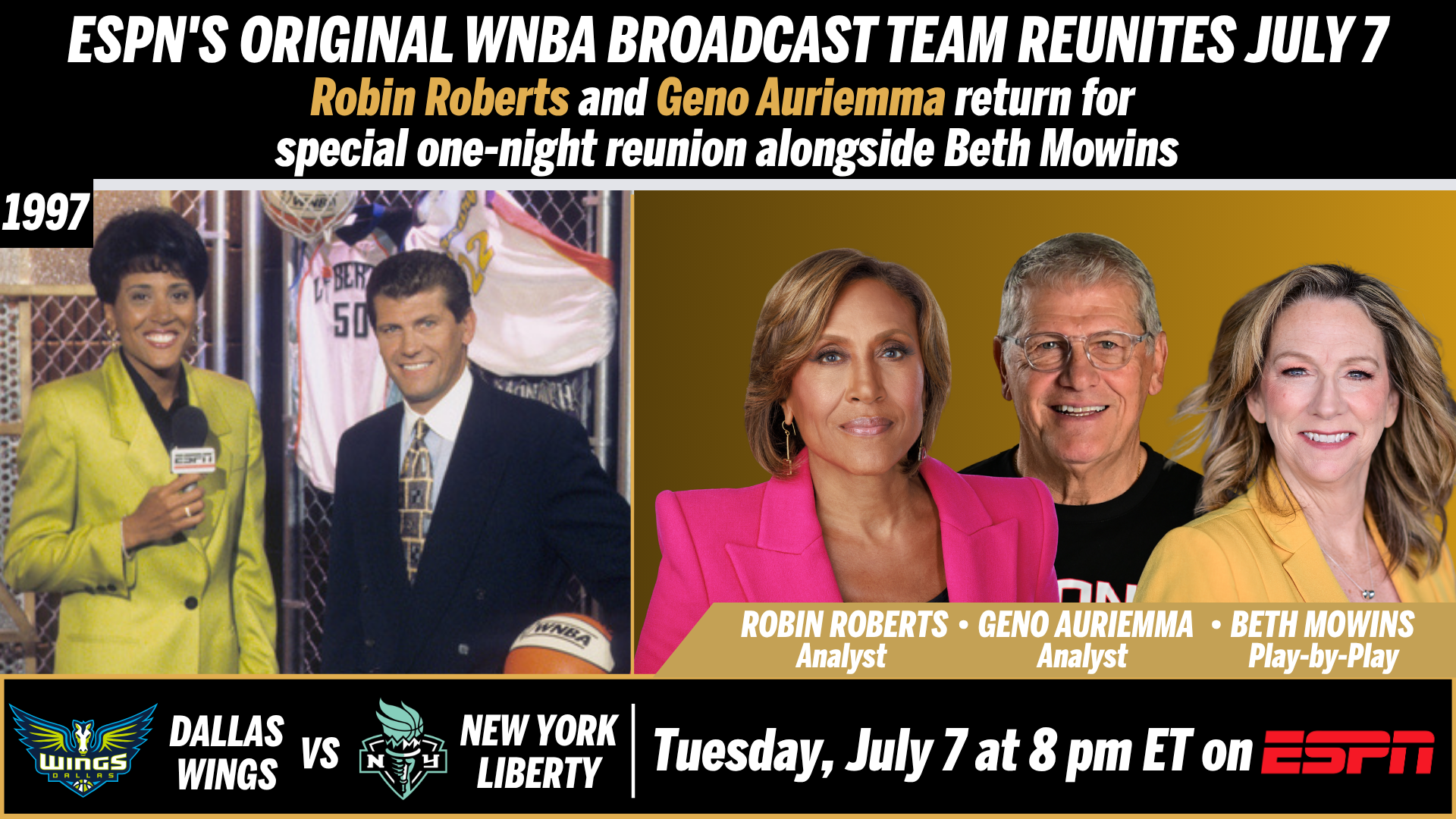
Robin Roberts and Geno Auriemma, who called ESPN’s first-ever WNBA game in 1997, along with Tim Corrigan, ESPN Senior Vice President, Sports Production, were made available to media on a conference call Tuesday morning to discuss their upcoming reunion broadcast of the Dallas Wings vs. New York Liberty matchup on July 7, the WNBA’s growth over the past 30 seasons and the league’s future.
TIM CORRIGAN: Thank you. We could not be more excited about bringing back Robin and Geno to call a game, and literally after celebrating the Liberty-Sparks game, that was just phenomenal on Sunday night and having Hannah Storm host our pregame there, you can see how much we are embracing 30 years ago and all the great things that happened then with the coverage of the WNBA in its infant season, and all the people who surrounded it, both with Hannah on the NBC side, Rebecca playing in the game and then calling it, and for us to be able to bring back Robin and Geno to a game, it was an easy choice and really fun thing to connect with these guys, and just got to go down memory lane a little bit about how much fun we had doing it the first time.
And just thrilled that there’s an opportunity here that we can celebrate the game for what it was then and for where we are now and really just looking forward to July 7th and everybody getting together in Brooklyn and launching this.
Couldn’t be more excited on our end in a number of ways, and just all the different platforms and ways that we’ll kind of look at this and break it down and celebrate it as we get to July 7th.
THE MODERATOR: Thank you, Tim. We will get into questions.
Robin, what does it mean to be back doing this again for you? Geno, you’ve got three of your former players potentially playing in this game with Paige, Azzi and Stewie. What does it mean to get a chance to call their game?
ROBIN ROBERTS: First of all, thank you. I can’t wait to be back with Geno doing this. We were remarking as we were looking at our photos from 30 years ago, it kind of took our breath away for all the reasons that you could imagine. It’s like going home again. It’s in my DNA. I’ve continued to follow the game, I have. I’m a regular at the Liberty games and Sun games because I am in Connecticut and in New York. It’s a celebration.
But I have to tell you, it’s a combo, nervous, excited, using a muscle I haven’t used in a while. But I know I’ll be in great hands.
GENO AURIEMMA: Yeah, I was nervous the first time I did it, because I didn’t know what I was doing and now that I remember back and having to do it again, knowing what could go wrong, I’m even more nervous.
The good thing is we have Beth, she’ll do all the hard work, and myself and Robin will just kind of talk about the things that we remember from back then. What went into putting the telecast together, the great, unbelievable group of people that we had supporting us that helped us, you know, do the games.
You think back to, we had to learn to pronounce some of the names of the players that were playing (laughing), because we had never seen them play before, some of them, around the league. And now they are all household names. It’s incredible how far it’s come and I’m glad we’re getting a chance to, as Tim said, go down memory lane and celebrate, and celebrate ESPN’s place in it, also. That was a big deal to have that group.
So, yeah, I’m excited, anxious, nervous, all those things.
ROBIN ROBERTS: Geno, will you be prepared this time? I remember you showed up and you had a napkin with a couple of notes. But you made it work. But you made it work.
GENO AURIEMMA: (Laughing) I have no idea, honest to God. We just tried, just figure out, let’s watch the game and see what happens and talk about what we see.
I do remember, one time, I said, “Hey, Robin, remember we went to lunch today at Roberto’s today? That’s a great place, wasn’t it?” And you go, “Yeah, I really liked it.”
And Tim is in my ear going, “Shut the hell up and talk about the game.”
Now that we are older, we can say whatever we want, Rob.
ROBIN ROBERTS: What are they going to do, fire us?
GENO AURIEMMA: Yeah, what are they going to do, fire us?
Talking about your former players, Paige, Azzi and Stewie, a zillion stories that could take up the whole broadcast. Is it cool to talk about them as professionals on there?
GENO AURIEMMA: Yeah, it’s always — for me, it’s a shake-my-head kind of thing, you know, when I think about the last 30 years and what’s happened and what a big deal it is now for young girls. You know, they are girls, teenagers still, 17, 18 years old, coming into college over the last 30 years with a dream of playing in the WNBA. That never existed before.
And then watching that dream play out, and watching these kids become women and have a voice and playing the game they love and getting compensated for it, and the number of people that enjoy it, yeah, and I happen to have a whole bunch of players in the league that I root for every night. And getting to actually watch live and talk about them. Yeah, I mean, I don’t have to coach them. So I can say all the things I’ve always wanted to say about them.
So I’m looking forward to it.
Curious, I remember back when it started, there was so much curiosity and questions about what was going to happen with the league, I think the ABL was still there. Can you just talk about what it felt like 30 years ago with the league, and then what changes surprised you or what you have been impressed about with the league over the last 30 years?
ROBIN ROBERTS: I’m thrilled. Thank you for asking that. Because, you know, 30 years ago, and yes, the ABL had started, as well, and I am old enough to remember that there were a couple of pro leagues when I was in college. But when we scrimmaged them, I was a freshman in college, and we scrimmaged the pro team in New Orleans and we won as a freshman in college. I knew that that league was not going to be around.
So people were always trying to compare it to leagues before. It’s always been a league, no pun intended, a league of their own, the WNBA. The backing of the NBA. Val Ackerman was the first then president, now we have a commissioner, but she was the president, was committed. The NBA, the owners backed it. And just to see how people have stopped trying to compare it.
It was so frustrating in the early years, and it’s like, did you do this with the NBA? Any fledgling professional league needs time, and I am so grateful that people stuck with it.
And to see now, it’s like, it’s in the conversation. I work here at Good Morning America. We have a lot of guys in the crew. They want to talk about the WNBA and it wasn’t always that way. I mean that sincerely.
To see the respect it has earned, the players are just incredible, and I’m just very grateful to see that it is getting the recognition that it’s getting right now.
GENO AURIEMMA: Yeah, I agree with Robin. I think in the beginning, now you’re going back 30 years ago, so the respect for women’s sports certainly wasn’t anywhere near what it is today. I think people viewed women’s sports as a charity case, a cause. You know, hey, let’s do something for the ladies because, you know, it just looks nice and sounds nice and makes us feel a whole lot better about being great human beings and all that.
So everybody every day felt like they had to prove that they belong. They had to prove worthy. And you know, because every other league that had popped up failed, it was just like, yeah, well, they are going to do this. But then at some point, it’s going to go away.
Obviously people didn’t know David Stern. He wasn’t going to let anything going away that he started, that’s No. 1, and it’s gone through a lot of changes since then. Obviously the NBA became less and less and less of a factor in terms of ownership, and now they are all back. They all want back in. Now there’s expansion teams, and now there’s, you know, a ticker across ESPN telling you every night who is playing, what the odds are, God knows. You know, highlights, they are part of Top-10 highlights. They’ve become mainstream. They’ve become part of the fabric of professional sports.
Did we all know that? Could we have predicted that? If Robin and I were sitting around after a game in these great places and having dinner and having a drink, hey, you know what, 30 years from now, these guys are going to be making millions of dollars? Yeah, right. We had no idea. We were doing it. Every day was a new day. I was just pinching myself, like hey, I’m here with Robin Roberts, Tim Corrigan and all the press and camera guys and best stats guys. Who has got it better than us?
What’s next for this league? What do you guys think is the next step in the evolution for them?
ROBIN ROBERTS: Well, I think, first of all, Geno, thank you. Golly, this is really bringing me back to memory lane. At the time, Geno was just taking off with UConn. He didn’t have to do what he did for us, and he really helped really bring an audience that we might not have — that would have been more difficult to get. So I want to give him his flowers with that.
But I think what we saw with the CBA, with the players standing up and the players saying, yeah, I was there at the All-Star Game where they had their shirts on saying, “Pay us what we’re worth.”
I think that that, for a lot of sports people, that legitimized it, like, oh, they are getting paid? Oh, there’s TV rights? For some reason, for a portion of the population, that legitimized it in their eyes. But I just think, well, we’ve got, what, 50 games next year? We have more teams coming in. We have a billion dollar team in Golden State. I think it’s just adding more of these teams, adding more games, and just continuing to put the highlights on SportsCenter. I think that’s very key.
But I just see it continuing, continuing to grow like that.
GENO AURIEMMA: Eventually, the thing I worry about, and obviously I’m a coach and I see it from that end of it and I see it as a spectator in the WNBA, but I’m looking at it through the fans and media side of it as well, is that now, I think the media, the public, are going to be way more discerning than they were 30 years ago, 35 years ago.
Now come these expectations of, all right, now you’re getting paid, now you’ve got TV rights, now you’ve got expansion, and now you’ve got franchise fees, now you’ve got highlights and you’re being treated like true, professional athletes. Now can we as coaches, as players, continue to put a great product on the floor, where people are going to go — that’s what happened in college, that’s what happened early on. People said, let me go check it out, because I don’t truly understand the hype and they go and they go wow, this is really good, and they keep coming back.
So I don’t want it to go unsaid that all of us have to keep working really, really hard to make sure the product and put a lot of pressure on the players that the product has to be really, really, really good, and it has to continue to get better. And the players are really, really good, not even in the same stratosphere as they were 30 years ago, and who knows where they will be 30 years from now. We have no idea.
But I think this group of players are at the forefront of the new generation of the WNBA, and there’s a lot riding on their shoulders. I’m proud of them and I’m rooting for them.
Preparation-wise, do you two need to vibe check before this happens to get any rapport back? And when you first did this, the WNBA was not the spectacle it is now. Does it create any pressure in your mind that this audience is so much more intense and interested? Does it pressure you to up your game for your current duties?
ROBIN ROBERTS: Those are two really good questions like that. Vibe check, Geno, what is our vibe check? Tim Corrigan reached out and he said, hey, you want to do a game?
I said, did Geno say yes? If Geno said yes, I’ll say yes. And he said, Geno said basically the same thing and that’s pretty much how we got into it.
GENO AURIEMMA: You can imagine that conversation. “Hey, Geno, you want to do these games?”
I said, “I’ve never done color before.”
“That’s all right, Robin doesn’t do play-by-play. That’s not her role. You guys will be great.”
ROBIN ROBERTS: I think the vibe check, Brian, was really, where do you want go to dinner the night before and what bar are we hitting after?
GENO AURIEMMA: That’s it.
ROBIN ROBERTS: But all of that is true. But I have to say, I’m really fortunate that I have a young producer on my staff who is really big into the WNBA. So it might be a little bit like Devil Wears Prada, I might have a little earpiece in my ear with her feeding me some info. I know that there will be some heightened interest. The audience watching now, it’s different. Before you could get away with maybe not knowing your stuff as much. This is a very, very savvy audience. They are very demanding. Social media, did we have — we didn’t have to worry about that, right, Geno?
GENO AURIEMMA: No. No. No.
ROBIN ROBERTS: That’s a little bit different in itself. But I’m taking it seriously. I am going to prep for it, even though I thank goodness for Beth Mowins, who is doing the play-by-play but I may nudge her and say, can I do a quarter or two of doing that? Because it’s more of my wheelhouse than being an analyst.
GENO AURIEMMA: We all have to be prepared, obviously, and I hope that the people watching can enjoy the fact that we are still here and we’re still here doing great things, Robin and I, and we want to lend our voice and our presence to remind people where it all began and where it comes from. I hope not, that they don’t expect us to be —
ROBIN ROBERTS: Oh, gosh.
GENO AURIEMMA: — Inside The NBA. I don’t think anybody is going to — but at the same time, we want to let people know what’s going on and we know who is who and we know what’s what and whose strengths and whose weaknesses and what it’s supposed to look like and celebrate all the things that they are going to do that are going to be amazing.
We are not there to reinvent, you know, broadcasting. We are not there to critique the game in a way that is going to, you know, revolutionize anything. We are there to add some fun and some flavor to an already great telecast.
Robin, last year it was announced that you were among the group of investors that joined the Liberty. So I’m just curious, like what made you want to be a part of that? Obviously you’ve been a long-time fan. And then Geno, when it comes to Breanna Stewart, obviously she’s had such an impact both on the court and off the court. When you just think about her legacy, and I know it’s weird to talk about legacy when players who are still playing at an extremely high level, what do you think is the greatest gift Breanna has given the women’s game?
ROBIN ROBERTS: Thank you for asking me that question. I got to know Clara Wu and her husband, the owners of the Liberty, and attending the game and being — even though I say I’m still from Mississippi, I’ve lived on the East Coast for more than half my life now. So I consider myself somewhat of a New Yorker, living in Connecticut, as well.
I want to put my money where my mouth is. I wanted to invest. I wanted to invest in women’s sports, and I do that as a broadcaster, making sure that they get the recognition and making sure of the stories and things like that.
But I thought it was very important for me to not just talk about investing in the game and having to raise the level of women’s sports, and it was an opportunity with the Liberty, and because I had gotten to know the ownership, the players, and being from the area, I just thought it was a natural.
And so I was just very happy that there was an opportunity to be able to do that, and I’m looking for other opportunities, and we see that more and more. People are literally investing in women’s sports, and I think for especially for someone like myself that has been at the forefront of trying to bring recognition to women, this is the next way of doing that for me, and for many others.
GENO AURIEMMA: Yeah, talking about legacies when players are still playing, that seems to be a common refrain. You know, right away, you see it everywhere. I remember watching something, Patrick Mahomes is playing to win his third Super Bowl, and something, what’s he playing for, what’s his legacy going to be. We jump to the things. Like right now, I’m living in the moment with Stewie and I think to myself, she’s already accomplished things that very few people will ever accomplish.
I doubt if anyone is ever going to win four national championships in a row in college. I can’t imagine that somebody else is going to do that. Maybe they will. And then go on to win as much as she’s won in the WNBA; and start a new league, which is incredibly successful; and help negotiate the new CBA; and have a voice she’s not afraid to use; and at the same time continue playing at the highest level.
I’m proud of her because it would be easy to say, look, I’m a basketball player and that’s it. But I think in today’s world, for the first time in a long time, you saw what happened on the men’s side. You see, George Foreman became more famous for his grills than he did for his boxing, which is crazy. People don’t remember Shaq playing. They remember all the things he’s involved in now, and Michael Jordan’s shoes are selling more now than when he played.
But women have never really had that kind of platform and runway to take off and do other things beyond just be excellent on the court.
So to have that opportunity and then take advantage of it, I just think it’s groundbreaking. I know there’s a lot of other people — A’ja Wilson is doing the same thing.
I’m so proud of them. Because when I met them, they were, you know, 17-year-old kids that when you asked them what the hell was that, “I don’t know,” you know, and now they are accomplished businesswomen and leaders.
To dig into the prep a little bit more, how are you guys approaching that over the next couple of weeks? Like you guys had mentioned earlier, obviously back in 1996, ’97, these are players that aren’t household names and you have to do a lot more digging, but now there’s more information and you are very familiar with both sides.
ROBIN ROBERTS: Like Geno was saying earlier, no one is expecting us to — the reason I hesitate is because I’m a journalist and I’m going to be prepared. Yes, it’s a celebration, and I want to have fun. But I want it to be a good broadcast. I know it will because it’s on ESPN, because of Beth Mowins and because of Geno, and yeah, we are going to yuk it up and we are going to have a good time.
I am going to do some serious prepping. When they first approached me, I was — can I do the whole game with Geno? Do we need a third person? And I was thinking of the audience, it would be a disservice if we didn’t have someone like that. We have to have a Beth Mowins there, who is doing the games and is going to be extremely prepared.
As far as prep work, I’m taping games — I feel like a coach. Talking with some of my staffers who are really big into the WNBA and being as prepared as I possibly can but also being in the moment. I just want to be in the moment. I think that’s the thing that Geno and I really excelled at that time. I think sometimes you can get too much in your head. It’s just going to be looking around and seeing that the top bowl isn’t cordoned off. Like when we were there, it was always the lower bowls in the stadiums, in the arenas that were being used.
So just taking in the moment, especially I’ve gone to a lot of New York games. It’s electric, and you know, hopefully Ellie won’t hit us upside the head, the mascot, but just try and stay in the moment.
GENO AURIEMMA: I agree with Robin wholeheartedly. What did the Knicks just win, Game 6?
ROBIN ROBERTS: 5.
GENO AURIEMMA: Won Game 5. I’m really a big fan of Mike Breen, Tim Legler and Richard Jefferson. Those guys were fantastic. Can anybody right now remember anything any of those three guys said? Can anybody remember anything that the analysts said?
ROBIN ROBERTS: That’s so true.
GENO AURIEMMA: The only thing they will remember if Robin and I say something so outrageous, so crazy, which we might do and they might remember that. I don’t know that there’s anything that we’re going to say that is going to be groundbreaking.
But the one thing that I’ve been thinking about is in order to legitimize what we were doing back then, we had to compare every player to an NBA player. Hey, who does that player remind you of? Oh, it reminds me of Isiah Thomas. Who does that player remind you of? Oh, she’s like Charles Barkley. I’ll never forget the Russian player, tremendous athlete, but built like Charles Barkley and we would say, “Yeah, she’s like Charles Barkley.” 30 years later, we don’t have to say that anymore.
Now we can talk about them in their own right and compare them to each other, the great players in the league. So we’ve got a whole different script to work with now. And we’ve seen these kids play through college, through the WNBA, through Olympics. We have more information now that we can — and there’s always too much information, anyway. I want to have fun at the game and also make sure that the fans watching have some fun.
What makes Paige Bueckers a good leader?
GENO AURIEMMA: The number one thing that I appreciate great about Paige is she’s a great teammate first. Because she’s a great teammate and genuinely cares about all of her teammates, it allows her to lead. She doesn’t go out there and say, well, watch me play, and do what I do. She does that, too.
But a little known fact when she was here at UConn, you know, she came in at the beginning of that NIL thing, and I remember saying to her, sophomore year, I forget when it was. I said, “All right, listen, we’re going to talk about how much money we’re going to give you.”
She’s like, “I don’t want it.”
I said, “Well, I kind of feel bad because you do a lot of these appearances and you do team things and you do — so I should compensate you for that.”
She said, “No, I don’t want it. Give it to some of these other guys because they need it.” She was making so much money off the court with all her deals that she had.
Every deal she signs, she signs a Croc deal, every kid gets mostly unlimited pairs of Crocs walking around here. She signs a Bose deal, every kid, every staff member, she goes around walking around handing out sets of Bose speakers, headphones. Everything she got she shared with everybody all the time.
So above and beyond the assists on the court, how she is as a human being off the court allows her to then inspire them to follow me.
And she didn’t want to do that as a young player, freshman year, sophomore year, even junior year sometimes. She just expected it to happen.
But I think since then, she’s taken on that, I’m responsible not just for myself but for the rest of the team. That comes across every time you watch her play.
THE MODERATOR: Thank you, all. That concludes this morning’s media call with Robin and Coach.
ROBIN ROBERTS: We got next!